


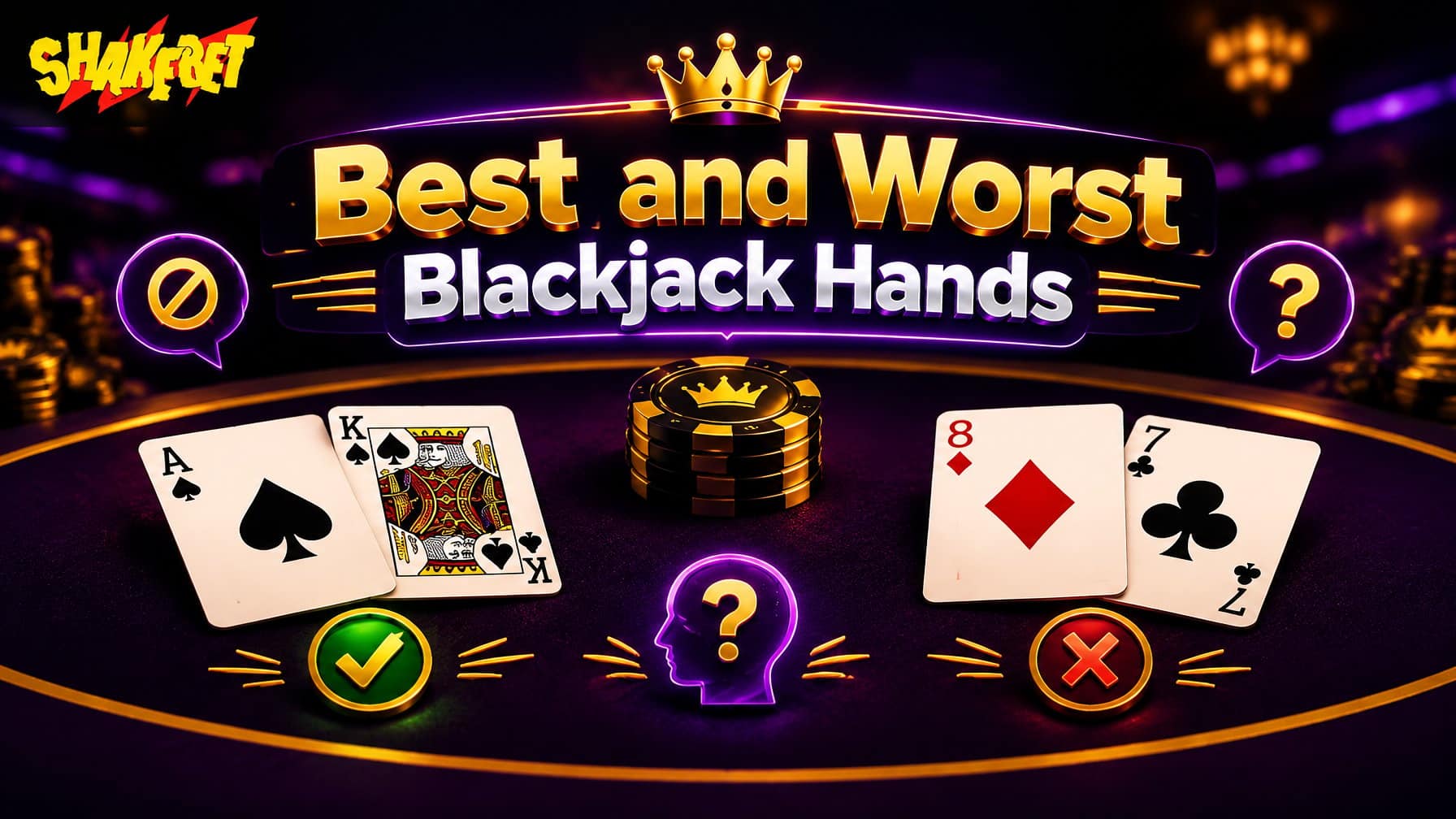
The Best and Worst Blackjack Hands aren’t always what they seem, some familiar beliefs can lead players to make costly calls. This guide clears up the myths, explains soft and hard hands, and shows how the dealer’s upcard changes your options.
We’ll also compare common hands by their general value and test a few popular claims. If you’re exploring blackjack at Shakebet online casino, use these tips to make more informed choices at the table.
The Hands Players Get Right and Wrong
Some blackjack hands look like easy wins, while others make players second-guess every move. The right play depends on the cards and table rules.
Below, each hand comes with a common mistake to watch for. New players can also check the rules and bonus promotions before choosing a game.
Blackjack: The Natural and Its Misconceptions
A natural blackjack is an ace and a 10-value card dealt as your first two cards. It usually pays 3:2, but some tables offer 6:5, so check the payout before you play.
One common misconception is that a natural always wins. If the dealer also has a natural, the hand is typically a push: neither side wins, and your original bet is returned. The exact handling can depend on the game’s rules, so read the table information first.
Good Totals and Good Starts: Where Players Slip
A hard 20 is a strong made total, and basic strategy generally says to stand. Splitting a pair of 10s just to chase two hands usually gives up a valuable 20. Strategy charts from sources such as the *Wizard of Odds* support keeping the pair together in standard games.
A starting total of 10 or 11 often offers a chance to double, depending on the dealer’s upcard and the rules. The mistake is doubling automatically, or never considering it. Check a basic-strategy chart for the specific game, since the recommended play can vary with the dealer’s card and table rules.
Pairs: Splitting Mistakes to Avoid
Players often keep aces together because they already make a promising total, or split tens because two hands seem more exciting. Basic strategy generally recommends splitting aces and eights, while keeping tens together. Splitting eights turns a hard 16 into two fresh hands; splitting aces gives each hand a chance to build from an ace.
Splits can require an additional bet, so check the table rules and see the welcome bonus for its current terms. A promotion doesn’t change which play the strategy recommends.
The Worst Hands and How Players Mishandle Them
Hard 16 and the other stiff totals, hard 12 through 15, can feel like blackjack’s awkward middle seats. Hit, and you might bust; stand, and the dealer may beat you. That tension makes it easy to freeze or choose based on fear rather than the full situation.
The dealer’s upcard matters. A hard 16 against a strong dealer card is different from a 16 against a weaker one, and surrender may be an option under some rules. Don’t use “always hit” or “always stand” as a shortcut.
Check a basic-strategy chart for your game and its rules; the Wizard of Odds blackjack guide explains why decisions depend on the matchup. When you’re ready to browse, check the games list and review each game’s rules.
Soft Hands: Mistakes and Good Habits
A soft hand includes an ace that can count as either 1 or 11, giving you more room to draw without immediately busting. But “safer to hit” doesn’t mean “always hit.”
Use the dealer’s upcard and the table rules to guide your choice. Basic strategy may recommend standing, hitting, or doubling with a soft total, depending on the situation. Check a chart matched to the game rather than treating every soft hand the same.

Hard Hands: Mistakes and Good Habits
A hard hand has no ace that can flex between 1 and 11. One common mistake is standing on every stiff total to avoid busting; another is hitting without checking whether the dealer may be in trouble.
Compare your total with the dealer’s upcard, then follow a basic-strategy chart for that game’s rules. The Wizard of Odds guide outlines how those details shape the recommended play.
Why Good and Bad Hands Are Not What They Seem
A hand’s strength depends on more than its total. The dealer’s upcard, the table rules, and whether you’re looking at an opening hand or a final total can all change the best decision.
That’s why a hard 16 isn’t simply “bad,” and a soft 18 isn’t automatically “good enough to stand.” The common misunderstanding is that each total has one correct move in every situation.
In reality, basic strategy compares your hand with the dealer’s upcard and accounts for the game’s rules. Check the Wizard of Odds blackjack strategy for examples and strategy details.
Ignoring the Dealer: The Costliest Hand Mistake
The dealer’s upcard helps show how risky it may be to stand or how useful it could be to let the dealer draw. Ignoring it means making a decision with half the picture missing.
In blackjack, dealer cards 2 through 6 are generally considered weaker upcards because they leave more room for the dealer to bust while drawing to a qualifying total. That doesn’t mean the dealer will bust, it’s a probability, not a promise.
For example, hard 12 may call for standing against a dealer 4 but hitting against a dealer 10. Hard 16 can also play differently depending on the upcard and whether surrender is available. Use a chart matched to the rules.

Playing Without Checking the Rules
Table rules change the value of hands and can affect the right play. Before you sit down, check the blackjack payout, number of decks, whether the dealer hits or stands on soft 17, and whether surrender is allowed.
A 3:2 blackjack payout is better for the player than 6:5. More decks generally raise the house edge, while a dealer hitting soft 17 is less favorable to the player than standing. Surrender, when available, can reduce losses in certain situations; its value depends on the hand and rules.
The Wizard of Odds guide explains common rule effects. If you’re browsing a games lobby, review the rules before trying a blackjack double down.
Myths About Strong and Weak Blackjack Hands, Tested
Blackjack myths often turn a useful rule of thumb into an “always” rule. Basic strategy shows why the details matter:
- “Always stand on 16.” Verdict: False. The dealer’s upcard and surrender rules can change the recommended play.
- “Always split 8s.” Verdict: Usually, under standard strategy, but check the rules and situation. A pair of 8s starts as hard 16, and splitting gives each hand a fresh start.
- “Split every pair of 10s.” Verdict: False. Basic strategy generally keeps them together as 20.
- “Soft 18 is always a stand.” Verdict: False. The dealer’s upcard can make hitting or doubling preferable.
- “A 3:2 and 6:5 blackjack payout are basically the same.” Verdict: False. The 3:2 payout returns more on a winning natural.
The Wizard of Odds blackjack guide covers these decisions and explains how rules shape strategy.
How Much Each Hand Is Worth: Expected Value Ranking
There’s no single Expected Value for a hand: it depends on the dealer’s upcard, table rules, and your available choices. The table uses one consistent example, a six-deck game where the dealer stands on soft 17, with a 3:2 blackjack payout and dealer peek.
Values are illustrative, per unit initially bet; the exact figure changes with card composition and play decisions.
| Hand | Dealer Upcard Assumed | Expected Value (per unit bet) | Source |
| Blackjack (natural) | Dealer has no natural | +1.50 | Wizard of Odds |
| Starting 20 | Dealer 6 | About +0.70 | Wizard of Odds |
| Starting 11 | Dealer 6 | About +0.65 | Wizard of Odds |
| Pair of aces | Dealer 6; split | About +0.40 | Wizard of Odds |
| Soft 18 | Dealer 6 | About +0.20 | Wizard of Odds |
| Hard 16 | Especially dealer 10; compare low card too | About +0.20 | Wizard of Odds |
| Hard 12 to 15 | Compare dealer 2–6 with 7–ace | Depends strongly on upcard | Wizard of Odds |
These are examples, not universal values: the source tables separate hands by exact composition, dealer upcard, and rules.
Players often overvalue a hard 16 because it feels close to 21, while undervaluing an 11 because it’s not yet a made total. The smarter comparison is the expected return of each available play in that specific situation.
Blackjack Hand Mistakes: Questions Answered
-
A hard 20 is generally the strongest regular total after a natural blackjack. It can still lose to a dealer’s blackjack, or to a dealer who reaches 21 with three or more cards. Usually, though, standing is the sensible play.
-
Hard 12 through 16 are often the trickiest totals because hitting can bust you, while standing can leave you behind. The best move changes with the dealer’s upcard. The Wizard of Odds basic-strategy guide shows how the matchup matters.
-
A natural blackjack beats a dealer’s 21 made with three or more cards. But if the dealer also has a natural blackjack, the hand is usually a push and your original bet is returned. Check the table rules for the exact payout.
-
An ace counts as 1 when counting it as 11 would put your total over 21. That’s why a soft hand can become hard after you draw. The ace doesn’t disappear, it simply switches value to help keep your hand from busting.
-
Usually, yes, if the table allows it and you place a separate bet on each hand. Playing two spots means managing two wagers at once, so beginners may find it easier to start with one and focus on basic strategy.